
APE : alerte générale sur les emplois à La Réunion, résultat de l’aliénation
9 juin, parRisque d’anéantissement des emplois liés à la production de richesses à La Réunion


Tomorrow on the road to COP-15
3 November 2009
A one-time train link between Kyoto and Copenhagen opens up this week – a United Nations-sponsored one-month, 9,000-kilometre journey symbolically joining the site of the last global warming pact with what is hoped to be the birthplace of the next major, and stricter, treaty to combat climate change. Following, an UN press release is explaining this action.
Launched by the UN Environment Programme (UNEP), the International Union of Railways (UIC) and the global conservation organization WWF, the Train to Copenhagen – in fact a carriage – will roll across the globe through the vast wilds of Russian Siberia and into Europe as part of the UN Seal the Deal! campaign to galvanize political will and public support for reaching a comprehensive global climate agreement in December.
Train operators from around the world will participate in the Train to Copenhagen, raising awareness of the impact of the transport sector, which already accounts for over one fifth of global CO2 greenhouse emissions. These emissions are projected to double within only 40 years and railways are crucial in reducing greenhouse gas emissions and developing sustainable transport systems.
“We are on the road to nowhere if existing policies and economic models prevail with their over-emphasis on private cars and on shifting shipments of goods to the roads,” UNEP Executive Director Achim Steiner said. “The Train to Copenhagen project is a showcase of sustainable transport solutions that will be part and parcel of a resource-efficient, low-carbon Green Economy of the 21st Century.
“By Sealing the Deal on an ambitious climate agreement in Copenhagen, governments will get into gear to propel the world to a low-carbon future so that societies may also finally embark on a journey to more sustainable transport.”
During the journey, environmental experts and climate change campaigners will send eye-witness accounts of global warming signs under way. Siberia is a global climate change hotspot, where thawing permafrost and melting peat bogs could slowly release billions of tons of methane and carbon dioxide into the atmosphere over coming years.
The Train will roll out of Kyoto station on 5 November – leaving behind the Japanese city where the Kyoto Protocol that sets binding greenhouse gas reduction targets for 37 industrialized countries and the European Union (EU) was adopted on 11 December 1997 – and make its way by ferry to Daejeon, Republic of Korea (ROK).
There it will board another ferry for Vladivostok in Russia’s Far East for that vast transcontinental journey to drum up support for a new compact with much stronger cuts to replace the Protocol on the expiration of the first commitment period at the end of 2012.
Rumbling across Siberia, it will be hauled along the famous Trans-Siberian Railway and go by ferry across Lake Baikal, the most voluminous freshwater lake in the world, and stop in Moscow, the Polish city of Poznan and then Berlin before arriving on 5 December in Brussels, where it will join the Climate Express, which will be powered by 100 per cent renewable energy.
This Express will take on board more than 400 climate change negotiators, campaigners and other high-profile personalities going to Copenhagen, for a 12-hour on-track conference focusing on how to solve the challenges posed by the transport sector with regard to global warming.
On arrival, the Climate Express will remain at Copenhagen Central Station throughout the two-week conference, serving as a mobile exhibition open to the public about low-carbon transport solutions.
“It is clear that business as usual is not an option if we want to reverse current trends and prevent catastrophic climate change,” UN Framework Convention on Climate Change (UNFCCC) Executive Secretary Yvo de Boer said. “If we can really integrate the costs of pollution into the price of transportation, rail will be a big winner.”
Risque d’anéantissement des emplois liés à la production de richesses à La Réunion

Mézami mi rapèl lo tan nou téi koné fé gran-gran lopérassion : kissoi bann miltiplikassion plizyèr shif, kissoi bann divizion, kissoi mèm lo (…)

L’ouverture aux services de l’Accord de partenariat économique (APE) entre l’Union européenne, les Comores, Madagascar, Maurice et les Seychelles (…)

In kozman pou la rout
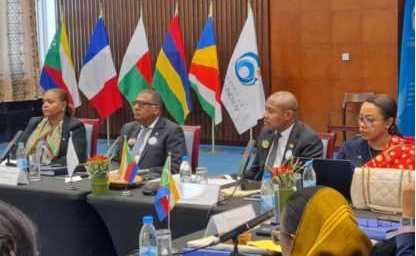
Communiqué officiel du 40e Conseil des ministres de la COI
Qui a dit que le peuple réunionnais était condamné à subir les schémas descendants de la mondialisation marchande et à n’être que le spectateur (…)
Au lieu de reproduire la France, les Réunionnais devraient s’inspirer de Madagascar
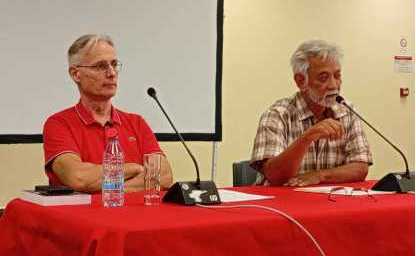
Retour sur le séminaire organisé par la Section PCR de Saint-Denis

Conséquence de la crise et de la pénurie de logements sociaux
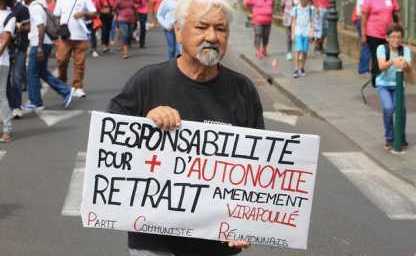
Condoléances du Parti Communiste Réunionnais
Face aux difficultés de trésorerie à cause des retards de paiement

À la veille de la manifestation organisée par des élus devant la préfecture


Forum posts
21 November 2009, 09:24
Achim Steiner, the Executive Director of the United Nations Environment Programme, will board the train alongside Franny Armstrong, the producer and director of the film ’The Age of Stupid’, Luo Hong, the wildlife photographer and UNEP Climate Hero, and Apa Sherpa a WWF Climate Witness who holds the world record for the most ascents of Mount Everest, Yoshio Ishida, UIC Chairman and Vice Chairman of East Japan railways, Jean-Pierre Loubinoux, the Director General of the International Union of Railways (UIC). They will be joined by top rail executives including as well as other passengers from the media, to business leaders, to civil society
21 November 2009, 09:25
The Climate Express train, will travel from Brussels to Copenhagen on 5 December and will be the final leg of the ’Train to Copenhagen’ project, organized by the International Union of Railways (UIC) with the support of the UN’s Seal the Deal! campaign and WWF, the global conservation organisation. The ’on-track’ conference aims to raise awareness of the transport sector’s influence on climate change, and provides a key opportunity for the passengers on board to debate the key climate talks ahead, during workshops and round table discussions on the different aspects of sustainable mobility, and how this could be addressed in a post-2012 agreement.
21 November 2009, 09:25
Connie Hedegaard, the COP 15 host and Danish Climate Minister and Søren Eriksen, CEO of the Danish Railways (DSB), will welcome the Climate Express at arrival in Copenhagen.
21 November 2009, 09:26
Also as part of the ’Train to Copenhagen’ project, the UIC Climate Change and Rail Seminar will kick off on 5 November in the Japanese city of Kyoto - the birthplace of the current Climate Change Protocol. The seminar, co-organized with the Asian railways, will highlight how transport can be part of the solution in the fight against global warming.
21 November 2009, 09:27
To underline what railways have to offer, a Global Rail Position Paper will also be carried by rail via Vladivostok, Moscow, Berlin and Brussels before reaching Copenhagen. Based on data gathered from international railways, the paper advocates a shift to rail from road and air as a crucial step to support transitions to low-carbon mobility.
21 November 2009, 09:28
During the journey through Russia, environmental experts and climate change campaigners will report on the signs of global warming underway via www.traintocopenhagen.org and on Twitter at http://twitter.com/Trn2Cpnhgn.