
APE : alerte générale sur les emplois à La Réunion, résultat de l’aliénation
9 juin, parRisque d’anéantissement des emplois liés à la production de richesses à La Réunion

6 October 2009

The world’s countries continue to record substantial improvements in human development but vast inequalities still exist between rich and poor States, the United Nations Development Programme (UNDP) warned yesterday as it unveiled its annual measure of progress in human well-being.
The Human Development Index (HDI), which combines measure of life expectancy, literacy, school enrolment and gross domestic product (GDP) per capita, was this year calculated for 182 countries and territories – a record number – and released today as part of the annual Human Development Report.
The report’s lead author Jeni Klugman said “progress has been uneven” worldwide, despite significant overall improvements over the past 30 years.
“Many countries have experienced setbacks over recent decades, in the face of economic downturns, conflict-related crises and the HIV and AIDS epidemic,” Ms. Klugman said. “And this was even before the impact of the current global financial crisis was felt.”
She noted that some countries have made particularly strong progress since 1980 in health and education, especially compared to incomes.
“While the closing of the gaps in many health and education indicators is good news, the persistent inequality in the distribution of world incomes should continue to be a source of concern for policy-makers and international institutions.”
Norway, Australia and Iceland remain the top-ranked countries on the HDI, which is based on data gathered in 2007, the most recent year that full statistics were available. Canada, Ireland, the Netherlands, Sweden, France, Switzerland and Japan complete the top 10.
They are among 38 countries and territories classified as having “very high” human development, a new category reserved for those nations with the highest indicators.
Across the entire HDI, five countries rose by three or more places: France, Venezuela, Colombia, Peru and China, due largely to improvements in life expectancy and incomes. Luxembourg, Malta, Ecuador, Lebanon, Belize, Tonga and Jamaica all slid in the rankings by three or more places.
Niger, Afghanistan and Sierra Leone are at the bottom of the rankings, and Ms. Klugman noted the enormous differences in the life of a child born in Niger to that of one born in Norway. The Norwegian child can expect to live 30 years longer and will grow up to earn an average of $85 for every $1 earned by the person in Niger.
Risque d’anéantissement des emplois liés à la production de richesses à La Réunion

Mézami mi rapèl lo tan nou téi koné fé gran-gran lopérassion : kissoi bann miltiplikassion plizyèr shif, kissoi bann divizion, kissoi mèm lo (…)

L’ouverture aux services de l’Accord de partenariat économique (APE) entre l’Union européenne, les Comores, Madagascar, Maurice et les Seychelles (…)

In kozman pou la rout
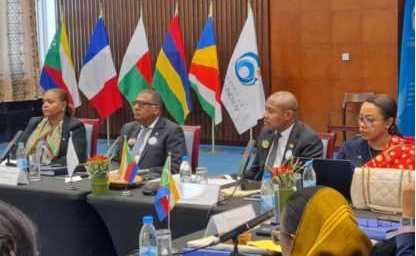
Communiqué officiel du 40e Conseil des ministres de la COI
Qui a dit que le peuple réunionnais était condamné à subir les schémas descendants de la mondialisation marchande et à n’être que le spectateur (…)
Au lieu de reproduire la France, les Réunionnais devraient s’inspirer de Madagascar

Retour sur le séminaire organisé par la Section PCR de Saint-Denis
Conséquence de la crise et de la pénurie de logements sociaux

Condoléances du Parti Communiste Réunionnais
Face aux difficultés de trésorerie à cause des retards de paiement

À la veille de la manifestation organisée par des élus devant la préfecture


